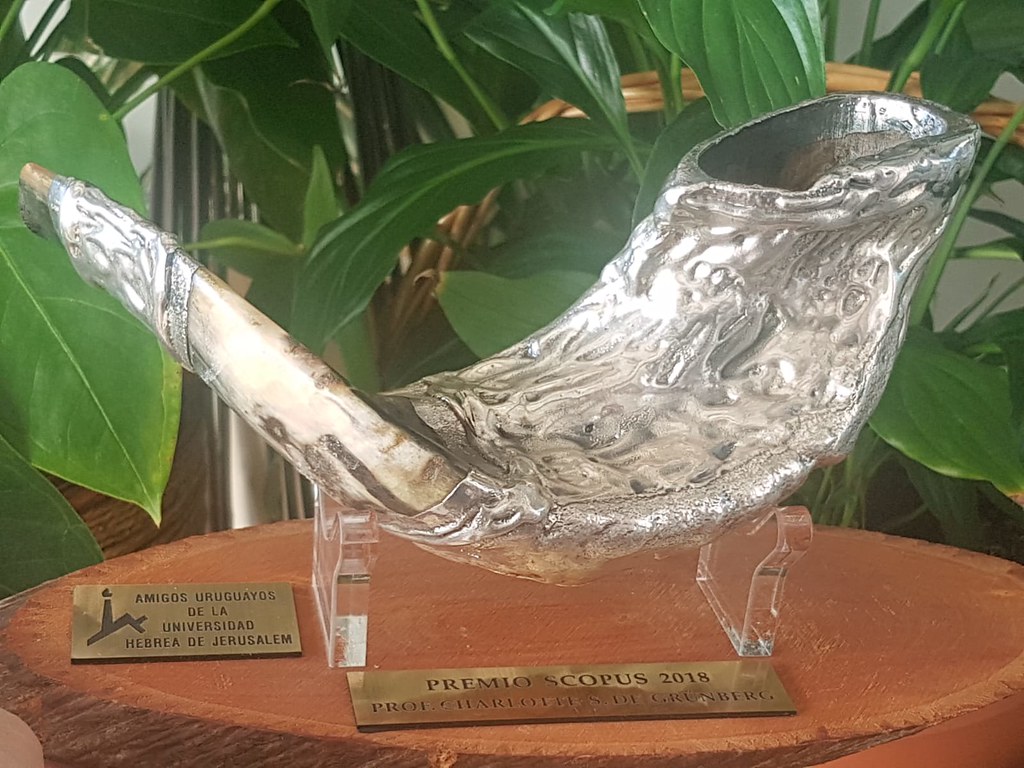
The Scopus Award is presented to an individual or an organization that has excelled in their respective fields and whose humanitarian efforts and outstanding commitment have contributed to the betterment of the Hebrew University, the State of Israel, the Jewish people, and humanity.
This year, according to Dr. Gabriel Goldman, Chairman of the Friends of the Hebrew University of Jerusalem in Uruguay, the Board of Governors of the HUJ approved the request from the Uruguayan organization to present this award on its behalf. The prize consists of a shofar inlaid with gold and silver, mounted on a wooden base.
During the presentation, Dr. Goldman explained the reasons for awarding the first Scopus Award to Prof. Charlotte de Grünberg, noting the Director General’s career since her arrival in the country in 1952, and highlighting her role in the founding of Universidad ORT Uruguay, her involvement in coordinating international projects in underprivileged neighborhoods of Montevideo, and her work as coordinator of World ORT for Latin America.
Then, before an audience of nearly a hundred relatives and friends who had gathered to support the Director, a video was shown featuring Mr. Yossi Gal, Vice President for Development and External Relations at the Hebrew University, who congratulated Prof. Grünberg and highlighted her personal background, her career as an educator, and her support for the university.
The Director received the award from Dr. Goldman, along with the Israeli Ambassador to Uruguay, Galit Ronen, and Prof. Edwin Seroussi, winner of the 2018 Israel Prize. Prof. Seroussi, who this year received the highest award bestowed annually by the State of Israel, is a professor of musicology and director of the Jewish Music Research Center at the Hebrew University of Jerusalem (HUJ). He traveled to Uruguay—his country of birth—specifically to represent the University at this tribute.
Moved by what she saw as an "unexpected" honor, the Director General of ORT Uruguay emphasized in her acceptance speech (transcript available in Spanish and English) the importance of education for the Jewish people and, in particular, the role of the HUJ.
“Since the project was launched—something that was almost unthinkable at the time—the Hebrew University of Jerusalem has expanded its activities, which today encompass virtually all areas of human knowledge and have become a driving force for innovation,” the professor noted.
She also emphasized that 138 years ago, that same fighting spirit was alive and well among a group of Jewish thinkers in Russia. “This is how ORT was founded,” she said.
“Both the Hebrew University of Jerusalem and the ORT project managed to attract the attention of Albert Einstein and other prominent figures, who supported both initiatives from the very beginning. (...) Our institutions owe a great deal to all these tenacious visionaries and generous figures from the scientific community and the Jewish world of that time who supported these two ambitious dreams,” she stated.
To conclude her speech, she mentioned her family and her brother Raymond; also expressing her gratitude to Ruperto Long, a personal friend and author of the biographical novel "The Girl Who Watched the Trains Depart," along with her “colleague and friend” Dr. Adrián Moscovich, Executive Director of ORT Argentina, and President Luis A. Lacalle (1990–1995), Doctor Honoris Causa of the HUJ, who were also present at the gathering.
“I was deeply moved by this award, but even more so by the atmosphere and the warmth of everyone here,” said Prof. Charlotte de Grünberg, who received dozens of congratulations, including one from Mr. Avi Ganon, Director General of World ORT.
Event Summary
Full speech
Image gallery