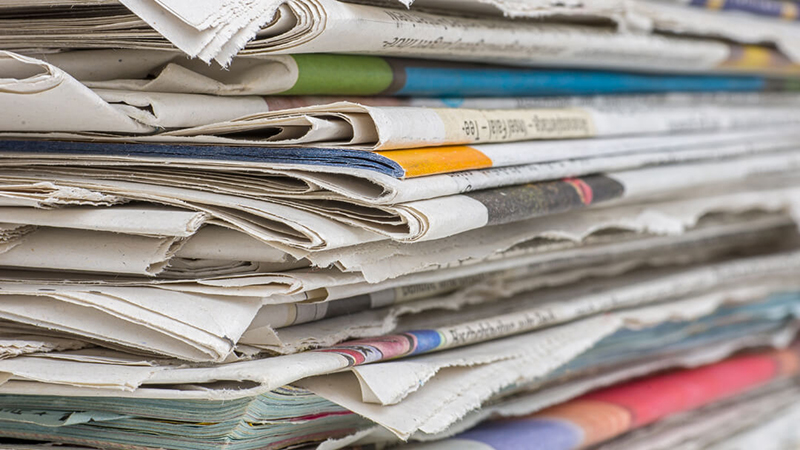
Paper is a material consisting of a thin sheet made from cellulose pulp, whereas cardboard is a material made up of several layers of paper stacked on top of one another.
A certain percentage of recycled paper fibers is always used in the manufacture of new paper. “This depends on the quality of the paper being produced; for example, toilet paper contains a higher percentage of recycled paper than computer paper,” explains Luís Horta, project manager at Abengoa - Teyma Medioambiente.
“The properties of virgin and recycled fiber are almost identical,” he says, adding, “The only difference is that once fiber is recycled, it becomes shorter, which means it can’t be used for certain types of paper, such as newsprint, which requires very long fibers to be more resistant to tearing.”
What types of paper can be recycled?
Not all paper is suitable for recycling.
That's why we've outlined below what you can and cannot throw away in the new recycling bins.
It is suitable for recycling:
- Magazines, books, notebooks (not hardcover)
- Newspapers
- Brochures
- Computer sheets
- Phone books
- Press clippings
- Cardstock
- Shoe boxes
Not suitable for recycling:
- Sticky notes
- Tracing paper
- Toilet paper
- Napkins
- Scarves
- Paper coated with moisture-resistant materials (paraffin, plastic or metal foils, silicone, etc.)
- Paper that is dirty, greasy, or contaminated with chemicals
What is recycled paper used for?
- New paper and cardboard
- Napkins
- Toilet paper
- Egg cartons
- Disposable trays
- Coffee filters
- Lampshades
- Planters
- Ceiling and wall insulation
For over a year now, Universidad ORT Uruguay has been partnering with the nonprofit organization Repapel, donating all the paper and cardboard collected at the institution.
This makes it very easy to track the materials, since everything collected is taken to Fabitech, where notebooks, cardstock, reams of paper, and rolls of toilet paper—among other products—are manufactured and then donated to schools.
Over the past year and a half, the university has already donated more than 3,000 kilograms of paper and cardboard.
Recycling process
The production of recycled paper consists of the following steps:
Separate collection of used paper in special containers.
Purification of the used paper pulp through filtering and centrifuging. This removes foreign objects from the fiber, such as staples, wires, strings, etc.
Separation of ink by flotation. To achieve this, the pulp is immersed in soapy water in a tank called a pulper. The ink forms a colloidal suspension, and the foam is caused to float along with the ink, allowing for mechanical separation.
Drying and pressing. The resulting pulp undergoes the same process as primary-source cellulose to produce paper. In other words, it is dried at 120 °C while being pressed and stretched to give it its final shape and texture.
https://www.youtube.com/watch?v=lm_P6AiV6ho