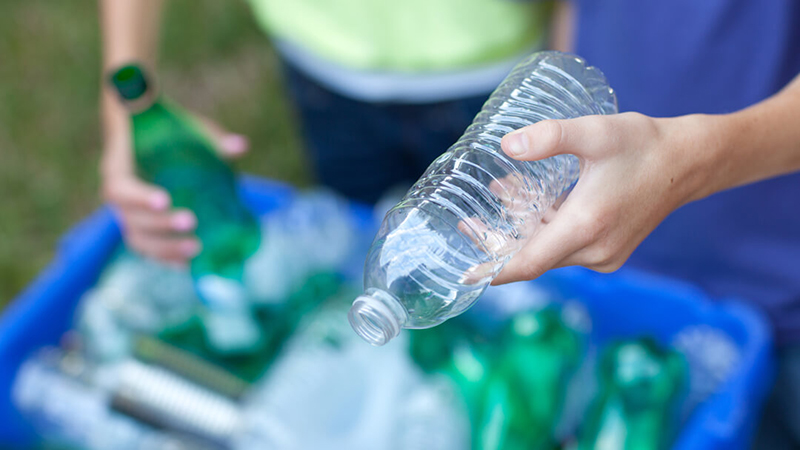
Plastic is a synthetic material derived from petroleum; its main characteristics are that it is inexpensive, durable, waterproof, and moisture-resistant.
Plastics play an important role in almost every aspect of our lives, as they are used to make everyday products, beverage containers, toys, clothing, and even furniture and car interiors.
Different types of plastics
Plastics all look the same, but they aren't. There are different types, and not all of them can be recycled.
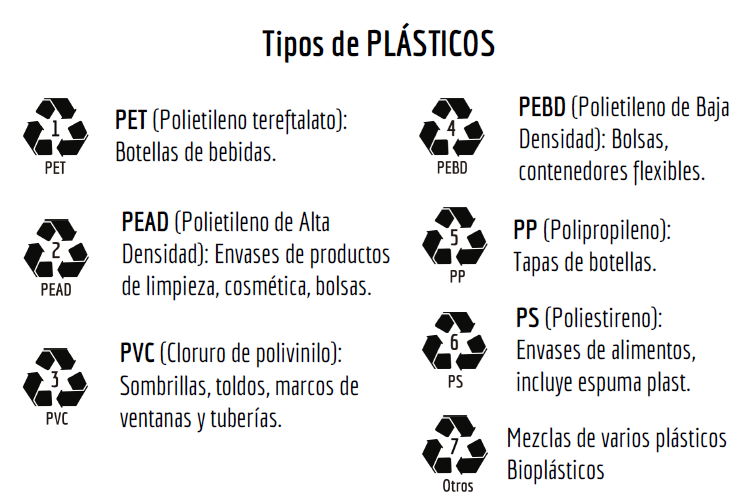
To help identify and sort plastic, there is an international resin identification code.
The code is usually located on the bottom of the containers and consists of three arrows that form a triangle with rounded corners.
Just because a plastic item has a recycling code doesn't mean it will be recycled locally through any recycling system. It depends on the type of plastic, the available technologies, the markets, and the quality of the collected material.
Inside each triangle is a number that identifies the type of plastic.
- PET (polyethylene terephthalate): Beverage bottles.
- HDPE (High-Density Polyethylene): Containers for cleaning products, cosmetics, and bags.
- PVC (polyvinyl chloride): Umbrellas, awnings, window frames, and pipes.
- LDPE (Low-Density Polyethylene): Bags, flexible containers.
- PP (Polypropylene): Bottle caps.
- PS (Expanded polyethylene): Food packaging, including plastic foam.
- PS (Polystyrene): rigid containers; its expanded version (EPS) is styrofoam.
- Others: Blends of various plastics; Bioplastics
How to Dispose of PET Bottles at College
To improve recycling:
- The bottle must be empty and thoroughly drained (it is important that there is no liquid left inside).
- Flatten it to save space.
- Put it in the yellow recycling bin.
What happens next? From PET to new bottles in Uruguay
In Uruguay, there is an industry ready to recycle PET and move toward a circular economy model.
A recent milestone (2024) is the introduction of technology that enables the “bottle-to-bottle” cycle: transforming a used bottle into food-grade recycled resin, which is then turned back into new bottles.
Recycled PET can also be turned into a wide variety of products.
Some of the most common uses include fleece fabric, sportswear, pillow stuffing, backpacks, and suitcases. It is also used to make boxes and trays, hangers, brushes, and other items.